Monday, October 29, 2007

Fathers and Daughters


Delaney and me on the carousel at Jantzen Beach


Volumes of research on daughters and sons consistently reveal that divorce hurts kids. That’s just the way it is. Daughters often feel abandoned, guilty, sad, and angry. They often become depressed. No matter how much a father tries to convince a daughter that it wasn’t her fault, it doesn’t matter. Up through adolescence, young people usually see themselves at the center of their family and friends, and they feel, whatever happens, happens in large part because of them…

But your daughter will also feel abandoned. She’ll ask “What was wrong with me? Wasn’t I worth sticking around for?” This is where you must begin to help her.

Your daughter expects parents to stay married. If she sees you or her mother renege on that commitment, she becomes confused. Heroes, in her mind, keep fighting. In reality, though, sometimes you can’t. If Mom leaves…your fight is limited.

But whenever, for your daughter’s sake, you can fight, you must. How you fight, how you persevere, how you manifest your courage will
always influence your daughter…This is what heroes do. It is what your daughter expects. Making the heroic choice at work, in marriage, and throughout your life will shape your daughter, who she is and what she becomes. You need to lead her wisely, consistently, and heroically.


--From Strong Fathers, Strong Daughters: 10 Secrets Every Father Should Know, by Meg Meeker, M.D.


I was already aware of the importance of a father in a young girl's life, but I was particularly impressed by the strength of the argument above. I will always advocate for Delaney.

Monday, October 15, 2007

Fathers and Sons, II

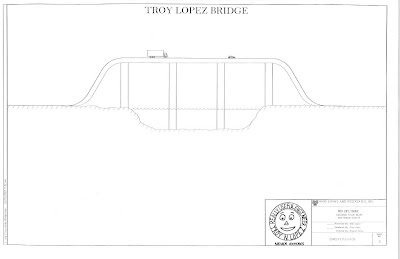
I think Troy gets his interest in bridges, and in construction, from me. He always asks whether I built a bridge that we might drive across or past. He’s said several times that he wants to be “an engineer AND a daddy…just like Daddy!” He’s also into Thomas the Train toys, stories, etc. As any fan of Thomas will tell you, the goal each day is to be named a “Really Useful Engine” by Sir Topham Hatt. Quite often when Troy does something helpful, or succeeds at something new, I will proclaim him a really useful engine, and he’ll always correct me with “You mean ‘engineer,’ Daddy. I’m a Really Useful Engineer!”

Two weekends ago, he drew a bridge on the chalkboard in his room that he would like me to build at work. I had his drawing converted into a more formal design document, complete with Troy’s own engineering stamp on it. No deviations were made from his design concept. Check it out below. (If it won't enlarge in your browser, the top portion of his seal reads "REALLY USEFUL ENGINEER" and the bottom half has his name. Below the stamp it reads "NEVER EXPIRES.")


Tuesday, October 9, 2007

The Photographs of Larry Towell

I didn’t discover Larry Towell’s photographs until a couple of days ago. Towell is a member of Magnum Photos (it is their website from which I’m pasting the pictures in this blog entry), who has traveled the world photographing the dispossessed, refugees of various conflicts, and landless migrants.


But his photographs of his own family are what caught my attention. Here is a picture of his son eating a pear from his wife’s hands in the old family pickup. For me, the boy’s eyes make this picture. I’ve always enjoyed watching my children’s facial expressions as they eat. This picture might have been even better were we able to see more of his wife’s eyes, but I still love it.


Here we see another son, suffering from a fever in the front yard. I was immediately drawn to this picture because my own son is getting over a fever and cold right now. I was reading to him a few days ago and he literally fell asleep sitting up and started to tip over. And it was only mid-afternoon. That was a sure sign that he wasn’t feeling well, and I was up most of that night listening to him cough. I have no complaints, as he asked me to sleep in his bed with him because he wasn’t feeling well. I gladly did so. So I can empathize with the young boy depicted here. And I’m heartened by the family dog’s apparent concern, as well.


Here is a picture of Mr. Towell’s daughter playing baseball with her brothers. This picture also struck a chord with me, as Troy and I have been including Delaney in our sporting games lately. Delaney’s particularly proud of the fact that she’s learning to throw a baseball, and she loves to play “keep-away” with the boys. Mr. Towell has captured the moment well here.


Finally, we come to a graphic expression of sibling love. Here is Mr. Towell’s daughter carrying her young brother through a river to “introduce him to water.” While I don’t agree with these kids being in a river without lifejackets, I see this kind of sibling love every day between Troy and Delaney. These kids adore each other, and I get the feeling that Troy wouldn’t hesitate to carry his sister through water if he ever had to. Delaney has started to assert herself a little more lately when it comes to “alone” time with me, but I think that our kids will have a very happy relationship to each other for life.


Monday, October 1, 2007

Fathers and Sons


I received a very nice surprise Saturday afternoon. My son and I were making a picture using some stickers he had of various pieces of construction equipment, such as bulldozers, jackhammers, hard hats, etc. Troy drew a construction worker and we put a hard hat sticker on his head. Then he drew a tiny little person next to the worker, and put a hard hat on his head. I asked Troy what the figure next to the construction worker was, and he said “It’s his son, Daddy!”

That warmed my heart. It was the first time I’ve heard Troy use the word “son” in a sentence, and it touched me that he thought of the father-son relationship on his own while creating his art work. That he didn’t need any prompting, and that we weren’t necessarily going to even include multiple people in the picture, made my afternoon. He added to this a few minutes later when he said that they were the “Daddy-Son Construction Company.” Thank you very much, Troy.

I’m also reading a book about a father-son relationship right now. Laughing Eyes is a collection of letters written over two decades between Edward Weston and his son Cole. The elder Weston’s Daybooks is essential reading for anyone with even a passing interest in the life of this great photographer, or with an interest in the life of an original creative artist. This book of letters is a nice extension of the Daybooks.

I’ve long thought (since becoming a father, anyway) that I could never be the type of itinerant photographer that Weston and Ansel Adams were for large parts of their lives. Adams was on the road photographing when his son was born; I cut both of my kids’ umbilical cords. Those men may have photographed in more exotic locations, but I’ve learned to find subject matter all around me wherever I am. And how I do love coming home to my kids each night!

There is a sequence of letters from Cole to Edward (Edward was on the road, photographing) that really drives this point home for me. I’ll reference two of them here:

March 24, 1926
Dear Papa
Are you well? When are you coming home?
ooooxxxxxxxx


Undated
Dear Dear Daddy
When are you coming home. Are you homesick. I have a black cat. Her name is Blacky. We are cleaning up the yard a little. Cut down a big tree for the grate.
I love you.
Cole.


I think that those letters would tug at the heartstrings of anyone reading this book. But to the father of two adoring children of my own, they are enough to put a lump in my throat. This is a wonderful book.

Monday, September 17, 2007

Nicholas Nixon's Family Pictures


It isn’t easy to find pictures from Nicholas Nixon’s Family Pictures online. Nixon is well-known for his pictures of AIDS patients, of school children, and for The Brown Sisters, but it seems that his family pictures remain in relative obscurity.

Which is unfortunate. I obtained a copy of this monograph a few months back, and I’m moved by it. These are pictures of his wife, Bebe, and his children Sam and Clementine. The pictures are warm, loving, and funny at times. These are more than portraits; these are scenes from life around the Nixon home when his two children were very young.

Amazingly, Nixon made these photographs with an 8x10 camera. 8x10. I’ve tried making portraits of my son with my 4x5 before, and wasn’t too successful at it. I would expect it to be much more difficult with an 8x10, particularly since these aren’t pictures in which Nixon’s children are posed before the camera. Longer lenses. More bulk. Longer exposures, in all likelihood. And energetic subjects, to say the least. But Nixon knows what he wants. He’s after the beauty of an 8x10 contact print, a sentiment I understand completely.

Somehow Nixon pulls it all off with grace in this charming little publication. Highly recommended for all parents with any interest in photographing their children.

Wednesday, September 12, 2007

A little introspection

The cover of Friedlander's second volume of self-portraits


I’ve begun a very exciting project that has reinvigorated my creativity, is always accessible, and is just plain fun. Partially inspired by Lee Friedlander’s two volumes of self-portraits, published about 30 years apart, I’ve started photographing myself with a 35mm camera, using a 24mm lens to produce a wide view, typically held at arm’s length. I try to photograph myself in some creative way or another every day. Sometimes I’ll stand in front of signs that seem relevant to my current situation (as at the intersection of Court and Church streets in Salem), sometimes I’ll photograph my shadow and legs on the ground in front of me, and sometimes I’ll simply point the camera at myself during my commute home after work. It has been a lot of fun so far, trying to see myself in new and unusual ways. Yesterday Delaney was asleep in the car’s back seat when we arrived at Troy’s preschool, so I slid into the seat next to her, put my face up next to hers, closed my eyes, pointed the camera at us, and snapped the shutter without waking her. It was cute.

My long-term intent is to do this as a sort of visual diary. By photographing myself every day, I hope to look back in time some day to see how I looked during certain milestones in my life, good and bad. Some day I’ll have a thorough visual record of my changing appearance over time, and by logging my feelings and thoughts each day (which I’m also doing), I hope to have a very introspective record of myself. I’ve described this project to my doctor, and he seemed to think it’s a good idea. And it feels like an artistic one, to boot. I’ve also described it to my favorite living photographer, and he said that it’s a “wonderful idea,” and that perhaps I could contact print several frames of negatives as strips on large boards, complete with the film’s sprocket holes. Sprocket holes included; now why didn’t I think of that?

I’ve burned six rolls of film so far, and I’m averaging about half a roll a day. There’s sure to be some good stuff in there, and I eagerly seek out opportunities to keep shooting each day.

On another note related to introspection, I’ve been reading some “success stories” recently of people who have dealt with depression and succeeded anyway. Yesterday I finished William Styron’s Darkness Visible, and I’m currently reading Lincoln’s Melancholy, How Depression Challenged a President and Fueled His Greatness. I find such success stories fascinating, and even more so when written by the depressives themselves. And I’m proud that I find myself able to keep my former condition at bay and actually use it for good, as a growth experience.

Monday, July 16, 2007

Another Loss


4 Generations


In addition to the break-up of my marriage, I have lost three family members in the past three months. While the first two were quite painful, the most recent one seemed to hit closest to home.

My paternal grandmother, Estella Lopez, died peacefully on July 7th. All 4 of her kids, as well as most of her grandchildren, were in the hospital room with her when she passed. She had been diagnosed with cancer a mere 8 days prior to her death, which also came on her daughter’s birthday.

In the dedication of my personal copy of my graduate thesis, I said that my grandmother “delivered this family from white cotton to white collar.” This woman constantly worked multiple jobs to care for her children when her husband left her. My father and his brothers worked in the south Texas cotton fields as very young boys to help the family out, but my grandmother held them all together. She was always particularly proud of the fact that she never needed help from welfare to support her four children—they made do on their own.

It was a very proud moment 10 years ago when I became the first member of our family to graduate from college—a moment my grandmother was there to share. But a memory just as strong was formed 3 years prior to that. In 1994, at the end of my freshman year, my dad and grandma came to L.A. to bring me home for the summer. We made the drive home the day after my last final, and had some quality time between the three of us. We stopped for the night when we got to Eugene, so that we could call on a cousin of mine for breakfast the next day. We were able to contact him, and my dad took us all out to eat. When I turned 30, my grandma gave me several pages of diary entries she had made in the previous 10 years, and she contemporaneously described that breakfast as being a very special treat. I’m very thankful that we could make that happen for her.

Eerily, she died on 7/7/07, and, as my uncle noted after she passed, “She always loved the slot machines at the casinos.” And as my cousin pointed out, “The only time she could walk fast was when she got to the casino.”

Rest peacefully, Grandma, and we’ll carry your torch.